
Narrative Infrastructure: Hiding in Plain Sight


I. Introduction
What does it mean for something to be everywhere and yet invisible?
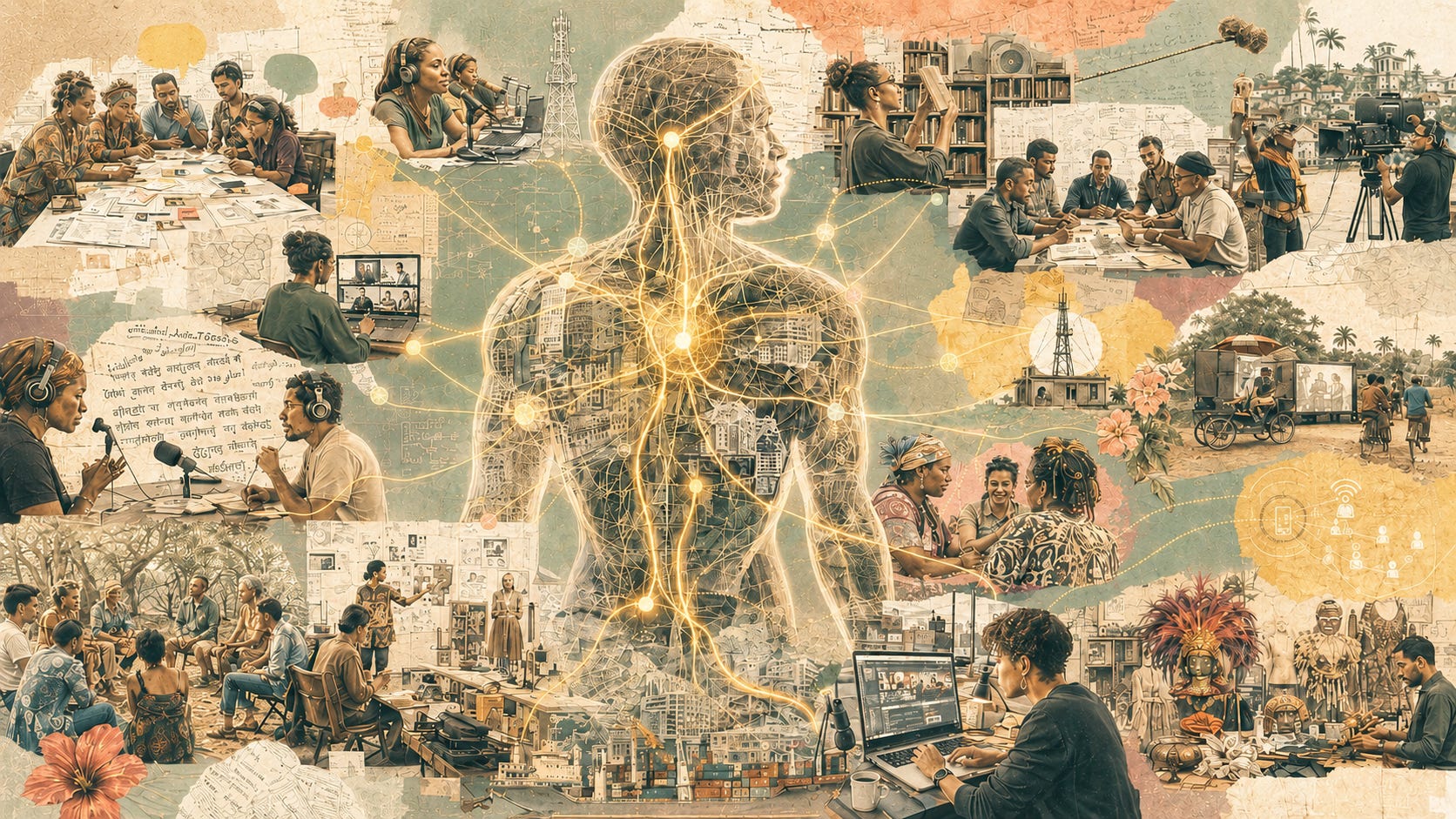
In 2018, medical researchers announced the discovery of a new organ. Not buried deep in some inaccessible corner of the body, but everywhere — a vast network of fluid-filled connective tissue cushioning every organ, threading through every muscle, present in every human being who has ever lived. It is called the interstitium.
As is the case with most “discoveries”, the interstititum was nothing new — it had been there all along. The reason it had never been seen was that the technique used to prepare tissue for the microscope — fixing, slicing, staining — drained the fluid, making it invisible. Ironically, the very act of trying to make the tissue visible destroyed the thing that needed to be seen.
We think narrative infrastructure has a similar problem.
For years, the field has been treating narrative infrastructure as a mystery still to be solved — convening to define it, debating what it includes, asking what it really is. Yet even though several people and organizations have offered useful, practical answers, the question keeps coming up fresh, as if asked for the first time.
II. A Shared Conviction
We are a small group of narrative practitioners, theorists, and funders working on narrative change from the Global South and East. We recently came together to think and strategize collaboratively about narrative infrastructure — what it is, why it matters, and how we can better resource, support, and nourish it from our different positions and perspectives.
What united us was a shared conviction that the field already knows a great deal about narrative infrastructure, and that this knowledge — built over years by practitioners with extensive experience and sophisticated models — deserves to be the foundation for the next set of conversations. Not conversations about what narrative infrastructure is, but about how to build it, resource it, and make it work better.
Not what, but how, what if, and which models work best.
We started by laying out what we already know.
III. What the field already knows (the conceptual ground we stand on)
As Sarah Stein Lubrano states in her book, Don’t Talk About Politics: “Infrastructures are enabling systems, they encourage certain kinds of actions and interactions. Roads take us places, schools teach us to be able to do things, the internet gives us digital action-possibilities and so on. Infrastructure shapes not only our action-possibilities but also our thought-possibilities.”
As a real world example of this, a recent article in Science references a range of studies showing that the architecture of the internet itself holds risks for democracy. Several pieces of research cited found that the mere availability of broadband internet increased affective political polarization. Clearly, we need to think about more than messages when it comes to narrative change.
One of the first people to prominently raise the issue of narrative infrastructure was Rashad Robinson in 2018, in his widely-cited article, Changing Our Narrative About Narrative. At the time Robinson was concerned with how to get the progressive sector to move from treating ‘narrative’ as a buzzword, to actually building narrative power.
Robinson draws a contrast between strategic communications — which he sees as operating at the level of society’s ‘software’, and narrative change, which he sees as aiming to change society’s ‘operating system’: the very “norms and rules our society lives by”. While the infrastructure for strategic communication consists of things like press lists, talking points, and powerpoint decks, the requirements for narrative power-building are much more extensive and deep-rooted: “In the end, we can define narrative infrastructure as the ability to learn, create, broadcast and immerse, and to do all four things strategically—both sequenced and integrated.”
Robinson listed three elements as necessary to build the power required to transform society’s operating system:
The resources (networks, platforms, funds and so forth) to work at scale and over extended time-frames to achieve society-wide narrative and cultural immersion.
People to do the work, who are skilled, motivated and networked.
Relationships with organizations and ideas, which Robinson defines brands — responsible for the way that most people come to “change their thinking, reshape their feeling, and redirect their behaviors”.
Robinson continues: “Narrative infrastructure is singularly about equipping a tight network of people organizing on the ground and working within various sectors to develop strategic and powerful narrative ideas, and then, against the odds of the imbalanced resources stacked against us, immerse people in a sustained series of narrative experiences required to enduringly change hearts, minds, behaviors and relationships”.
If the purpose of narrative infrastructure is to be able to build narrative power, then what is narrative power? Robinson defines it as the “ability to create leverage over those who set the incentives, rules and norms that shape society and human behavior. It also means having the power to defeat the establishment of belief systems that oppose us, which would otherwise close down the very opportunities we need to open up to achieve real impact at the policy, politics and cultural levels.”
In its publication, What is Narrative and Solidarity Infrastructure – and why are we building It? BLIS Collective talks about narrative infrastructure mainly as a kind of interconnected web that enables ideas to spread and take root on a society-wide scale. BLIS uses the analogy of a transport network consisting of things such as roads and bridges and subways, but in the case of narrative the web consists of “interconnected systems, services, relationships, and platforms”.
In an article in The Forge, Rachel Weidinger also talks about narrative infrastructure as a web — one that is layered and intertwined. Weidinger identifies four distinct layers of this web:
Conceptual narrative infrastructure, which consists of two elements:
conceptual frameworks, methodologies and metrics; and
the narratives themselves
Social and Technical infrastructure, which she defines as the network of relationships that connect the field, such as organizations, coalitions, gatherings, working groups and so on, supported by the technology that supports and enables these relationships.
Distribution infrastructure, that enables narratives to move from creation to dissemination to impact. This is perhaps one of the weakest links in the web for the progressive sector, since so many of the media and platforms essential for distribution are owned and operated by the opposition. Weidinger points to the urgent need for investment in conceiving and building people-powered narrative distribution infrastructure.
Finally, there is economic infrastructure: the resourcing, funding, and business entities that enable narrative organizing to take place at scale.
The Pop Culture Collab highlights six elements it sees as essential to the narrative infrastructure necessary for achieving narrative immersion, or what it also refers to as “transforming narrative oceans”. Its concepts of intelligence, collaboration, power, innovation and community map largely onto Weidinger’s ideas of conceptual, social and distribution infrastructure. However, the PCC also highlights leadership as an essential infrastructural element: “cultivating visionary leaders, pathbreaking organizations, and field-wide partnerships.”
ReFrame uses a slightly different metaphor to describe narrative infrastructure, seeing it as a “connective tissue” that connects the grassroots with other sectors such as academia, government, and entertainment. At the same time, narrative infrastructure consists of the set of technologies and protocols that enable research and equitable access, as well as what it calls “formations” for experimentation, learning and evaluation.
Elements of ReFrame’s definition seem to echo some of those in a draft definition formulated by Omar Mohammed, lead of the Global Narrative Hive. Like others, Mohammed includes relationships and resources, but adds that: “Infrastructure for us is not primarily about amplification or dissemination... It is about custody and the conferring of legitimacy. Who holds shared analysis. Who curates and archives memory. Who convenes and sets the terms of belonging.” He goes on to explain that any concept of narrative infrastructure must therefore also include “the set of relationships, resources, systems of legitimacy, and practices of solidarity that allow movements, especially in the Global Majority, to build narrative power, catalyse material change in people’s lived realities and retain narrative sovereignty.”
Mónica Roa, founder and executive director of Puentes, breaks narrative infrastructure down into two elements: the infrastructure for Narrative Change, and infrastructure for Narrative Power.
Roa views Narrative Change infrastructure as that which enables people and organizations to imagine and develop new stories, frames and metaphors — to come up with new narratives. This infrastructure consists of space, opportunities and resources, such as labs, art, research, experimentation and impact evaluation.
Narrative Power infrastructure is that which enables the new narratives to achieve real-world impact: ecosystems of networks, communities, platforms, movements and cultural mediators, that sustain new narratives and help them reproduce and become amplified and reappropriated until they become immersive; the new common sense.
Across these definitions, the differences matter less than the convergence. There seems to be broad agreement that like the interstitium, narrative infrastructure is the layered web, network, or interconnective tissue, consisting of people, technology, resources, ideas and relationships, that enables both the development of new narratives and their dissemination at scale — toward the social immersion and saturation required to shift the fundamental beliefs, rules, and norms of a society. And also like the interstitium, it may be easier to see, understand and better support by seeing it in action.
We believe it is high time the sector moves on from repeatedly trying to define in theory something that — as we show above — has been more than adequately defined, to spending our energy on understanding how narrative infrastructure operates in practice, in order that we may continue to improve, build and refine and sustain it.
IV. Social Justice Narrative Infrastructure in Practice
As with defining narrative infrastructure in theory, when it comes to understanding how it shows up in practice, we are not starting from scratch. We already have plenty of examples that show the workings of this pulsating interstitium.
For example, Nebula Fund has been supporting and working closely with Otros Ojos, a Mexico-based project working inside one of the world’s most influential media ecosystems. Mexico is the epicenter of the Spanish-speaking entertainment industry, producing content that reaches audiences across Latin America and the United States. For the past two years, Otros Ojos has been building the trust, relationships, and capacity within that industry to shift how gender gets told, one story at a time.
The team works directly alongside screenwriters, producers, and executives, not as external reviewers, but as creative partners. Rather than treating script consultation as a compliance exercise, Otros Ojos uses each project as an entry point into deeper conversations with creative teams about gender stereotyping, intersectionality, unconscious bias, and the real-world impact of representation. They meet industry insiders where they are, including through close relationships with Tinta, Mexico’s screenwriters’ guild. Across more than 60 scripts and 300 trained industry professionals, the results speak to the trust this approach generates: 100% of writers surveyed reported incorporating some of the team’s suggestions, and a significant number send revised scripts back — or bring new projects. In an industry where creativity and confidentiality are paramount, that kind of iterative, ongoing relationship is itself a form of narrative infrastructure, one that has shaped projects reaching tens of millions of viewers, including a film with 16 million views in its first two weeks and a telenovela with 6 million daily viewers. More than reaching individual stories, Otros Ojos builds narrative capacity for gender justice across dozens of them simultaneously, raising awareness, shifting creative instincts, and embedding gender-just thinking into the teams that will go on to make many more. The relationships are ongoing, the awareness stays, and with every new project those teams touch, the work adds up — quietly laying the ground for the gender-just stories of the future.
In 2023 IRIS – the International Resource for Impact and Storytelling — conceived, and collaborated with Puentes and the Global Narrative Hive to co-create Confluence — a gathering in Bogotá that brought together role players in the narrative change field from across the world. The aim was explicitly to bring together a range of different actors: narrative change practitioners, storytellers of various kinds, theorists, academic researchers from a range of disciplines, and funders — to connect, learn from one another and build relationships. The aim was also to demonstrate, make visible, to practitioners as well as to funders — that there is indeed a global narrative change field or community, and that it is developed, sophisticated and achieving some success. The Confluence organizers explicitly did not want to bring together the ‘narrative curious’, but people already experienced in narrative work, so that the gathering could move the conversation forward from ‘what is narrative change, and should we do it?’, to ‘how do we become better at it?’ Confluence in Bogotá was the first of a series of similar gatherings, and inspired regional spin-offs in Latin America and Asia. A WhatsApp group set up for communications during the event has developed into a lively online community that endures to this day. Several collaborations among Confluence participants were sparked by the relationships developed at that event. In addition to the Confluence community, IRIS has funded a narrative directory, enabling role players in the field to list themselves and find one another, and a narrative change resource hub within the Commons Social Change Library.
Puentes offers another example of narrative infrastructure in practice. Over the last several years it has developed platforms dedicated to reclaiming narratives around families and faith — two cultural terrains often dominated by conservative actors, yet research suggests they offer some of the strongest opportunities to engage and resonate with broad audiences across Latin America. The work focuses on building the conditions for narrative power: convening organizations, collectives, faith leaders, artists, and activists into communities of practice; supporting collaboration through narrative exploration awards; and creating spaces for training and collective learning. These relationships and structures have enabled the creation of music, books, podcasts, children’s literature, theatre productions, television series, and other narrative artifacts that reach audiences through multiple cultural pathways. The result is not a single campaign or message, but a growing ecosystem capable of generating, sustaining, and distributing alternative narratives over time.
In India, narrative infrastructure takes the form of what The Polis Project terms a modern ‘Underground Railroad’, moving stories from hyperlocal media within marginalized corners of society, into the broader national conversation with the aid of a range of actors, including English-first digital news organizations, digital creator networks, comedians and satirists, hyperlocal media, civil society organizations, and archival organizations.
In the Arab world, progressive media outlets grapple with how best to operate using a distributional narrative infrastructure that has benefits as well as serious limitations — consisting of social media platforms that enable them to reach and engage their audiences, while leaving them at the mercy of ever-changing algorithms and declining attention spans, and removing ability to control search or archiving.

V. Carnival
We have been using the Interstitium as a metaphor for narrative infrastructure, as it seems to us that medical science’s long ignorance of the interstitium – the ubiquitous but undervalued connecting tissue (infrastructure) that literally connects and holds everything together — mirrors the way narrative infrastructure has long been neglected. However, we must make an important distinction: the interstitium has always been there as a key organ in the human body, whereas narrative infrastructure is something that is constructed by humans. It needs conscious attention and investment if it is to serve us and help build and deploy narrative power.
We find the interstitium instructive on another level too. The fact that the conceptual and investigatory frameworks and habits within Western medical science literally prevented researchers from seeing the interstitium until a technological shift happened, offers an excellent illustration of the power of narrative itself: that believing often precedes seeing, rather than the other way around.
However, to understand what that infrastructure enables — the kind of society-wide change in assumptions, mindsets, and common sense; the widespread narrative resonance we need to bring about — another, somewhat different metaphor is needed. One that is immersive, visible, and impossible to ignore.
We found it in Trinidad and Tobago, where our small group gathered to build community, and to learn and strategize together, and where carnival is woven into the social and cultural fabric.
Whereas the Interstitium is a helpful metaphor for narrative infrastructure – that which is everywhere yet ‘invisible’, carnival is everywhere and hyper-visible, and thus a useful metaphor for narrative change itself.
Carnival is all-encompassing. Trinidad’s carnival belongs to everyone. It spills into the street, the neighborhoods, and practically every sector of society. It is, in the truest sense, immersive — an unavoidable, multi-layered experience that touches social relationships, identity, and the very rhythm of daily life. This is what distinguishes narrative change from strategic communication. Strategic communication sends a message. Narrative change, like carnival, changes the air everyone breathes.
But it is a useful metaphor for another reason — it embodies the upending of prevailing rules, power relationships, norms, and social assumptions — an analogy of what narrative aims to achieve. For a sustained period, the ordinary order of things is suspended — hierarchies are inverted, identities are reimagined, and what was fixed becomes fluid. This is precisely what deep narrative change aspires to do: not to tweak the message, but to shift the operating system.
And of course, carnival does not just happen. Behind the spectacle lies an infrastructure — the bands, the schools, the costume workshops, the sound systems, the traditions passed across generations, the institutional knowledge held in communities, and much more. Without that infrastructure, there is no carnival. The music does not move, the costumes do not get made, the streets do not fill.
Narrative infrastructure works the same way. It is what makes the immersion possible. It is what allows a new story, once created, to travel — to be amplified, reappropriated, and ultimately absorbed into the common sense of a society.
The examples in this piece — from Otros Ojos reshaping gender narratives inside Mexico’s entertainment industry, to the Confluence community, to the ‘underground railroad’ that enables progressive stories to circulate in India and the other examples above — are all, in their different ways, pieces of that infrastructure.
The question, then, is not whether we have the perfect definition for narrative infrastructure. We have a solid field that has given us important conceptual, field-informed tools. As with any living field, those definitions will keep evolving, sharpened by practice, challenged by new contexts, built upon, contested, and refreshed by innovation and creativity. The better question is whether we are willing to see it, name it, and invest in it — not as an abstraction, but as a concrete, living system that makes narrative transformation possible. We are not starting from zero. The field has generated rigorous conceptual frameworks, practical models, and hard-won experience. What we need now is not more definition — it is more intentional action.
VI. From Definition to Action, Building Narrative Change More Intentionally
In order to deepen and strengthen the work of more intentionally building narrative infrastructure, we propose the following strategies:
Build on what we already know. Think in systems, fund pragmatically. No single organization can or should try to do it all. What the field needs is a shared awareness of who is doing what, where the gaps are, and how different efforts can complement and reinforce each other.
For funders, this means moving beyond project-by-project logic toward a more systemic view: understanding the landscape, identifying what is missing, and resourcing the connective tissue — the networks, platforms, relationships, and institutions, as well as what Omar Mohammed refers to as forms of contribution that often go unnoticed: time, translation, listening, memory, experimentation. All of these are critical for the success of narrative work, and yet notoriously difficult to get funded, because they are not easily counted. This does not mean they are not real or concrete, however. As an example, at Confluence in Bogotá, the organizers put resources and effort into treating three languages — English, Portuguese and Spanish, equally throughout the meeting. Afterwards, several participants expressed appreciation for this, saying it enabled them to express themselves fully throughout the gathering in a way that was all too rare in international gatherings of this kind.
Building on what we already know does not have to be complicated. A practical starting point is simply to ask: who already has the relationships, the contextual knowledge, and the systemic perspective to help map and resource this ecosystem well? Across the Global Majority there are practitioners and organizations that have spent years building exactly this kind of expertise — understanding not just their own piece of the work, but how it connects to a larger whole.
Engaging them not only as grantees but as strategic partners — in advising, mapping, and even disbursing resources — is one of the most direct ways to move from systemic thinking to systemic practice
Develop the instruments to see it. As we have referenced in the point above, one of the deepest challenges facing narrative infrastructure is legibility. The impact of narrative change work is real, but the resources, networks and contributions that enable that impact can sometimes feel hard to see and even more difficult to measure — as can the slow, often diffuse steps over time that ultimately lead to visible successes. However, as with the interstitium the problem may lie more in our methods of observation than in the thing being observed.
The field has already begun to rise to this challenge. Promising evaluation approaches are emerging; and new tools developed at the intersection of movement practice and academic research are starting to make visible what conventional metrics miss.
Crucially, these methodologies allow us to trace both the more immediate results of narrative work and its longer-term effects — demonstrating that tracking impact is not only possible over time, but can yield meaningful insights in the short and medium term as well. Narratives shift in stages, and our measurement frameworks are beginning to reflect that.
For example, Nebula Fund is about to coordinate a pilot project in close collaboration with field practitioners from the Global Majority, applying a combination of outcome harvesting and attitude change methodology, to assess its usefulness as a learning and evaluation tool in the field of narrative change. The project aims to develop shared learnings and build a more robust evidence base for the field. At the organizational level, participating practitioners will gain rigorous, practitioner-generated evidence of their own impact — strengthening their learning, credibility, and ability to make the case for their work. At the field level, the pilot aims to produce a proof-of-concept for a flexible, field-rooted measurement framework suitable for organizations of any size across the Global South and East. And for the funding community, it will generate concrete, grounded evidence to better understand and communicate the impact of investments in narrative change — and a tool to bring new donors into the space.
More experimentation is needed — across contexts, scales, and methodological traditions, but the direction is clear: the field needs evaluation frameworks that match the complexity of the work, so that the most essential investments in narrative infrastructure become more visible, legible, and fundable.
We wrote this piece because we believe the field is ready to move. The conceptual tools exist. The practitioners exist. The models exist. If we want to translate the rich conceptual resources we already have into actual power shifts, we need the funding and the practices to keep the infrastructure healthy and growing.
What this moment calls for is a shift in how we resource, support, and learn from the work together, across our different positions and perspectives, from the ground up.
The interstitium was always there, and it’s about time we start acting like it, and leveraging its generative potential.
 | A guest post by
|
 | A guest post by
|