Twenty years ago, I bet on an underestimated tool. Today, I’m doing it again.
On May 20th, Colombia marked the 20th anniversary of the partial decriminalization of abortion. In recent days, I gave several interviews reflecting on that process and, as I answered questions about legal strategy, social movements, and cultural change, I kept thinking about the young lawyer I was back then: someone who, with a mix of naïveté and audacity, believed she had identified a tool with enormous potential for social change that was not yet being used “intentionally” in Latin America: strategic litigation.
That reflection inevitably led me to think about the work to which I now dedicate my efforts. Because I feel that, in some way, I am once again standing before a similar intuition. A different tool, but one with strikingly similar echoes. Available right before our eyes and yet still underestimated: narrative work.
When I led the design of the legal strategy that first opened the path to the partial decriminalization of abortion in Colombia—and in 2023 to its full decriminalization—there was something we understood very clearly: there were no guarantees of success. We could lose. But there was something even more important that we also knew: regardless of the judicial outcome, litigation was an opportunity to change the public conversation.
It was an opportunity to mobilize people, tell stories, and build communication strategies that could help society understand why criminalizing abortion was an issue of gender equality, social justice, human rights, and public health. If we won, that conversation would make implementation of the ruling easier. And if we lost, it would help us build enough social legitimacy to pursue other democratic paths for change.
We never understood strategic litigation as merely a conversation between lawyers and judges inside a courtroom. I insisted we understood it as a broader struggle over common sense.
Because behind the major litigation battles of our societies there are always deep narrative questions: When does human life begin, and how should it be weighed against other rights? What is a family, and which families deserve protection? What does it mean to be a “good mother” or a “good father”? Which lives are considered worthy of care? Who deserves autonomy, and who should be controlled? How far should state power extend?
These questions have animated some of the most important strategic litigation efforts in Latin America: cases on emergency contraception and abortion; equality marriage and the parental rights of lesbian mothers; gender violence and feminicide -including of trans women; Indigenous territorial rights; access to healthcare; and state accountability for dictatorship-era crimes and police violence.
Many of the most important legal cases of our time have not only produced legal change. They have also helped transform the cultural categories through which we interpret the world.
And I was fortunate to be part of a generation that helped build a political and narrative practice around strategic litigation. A practice that gained legitimacy, infrastructure, funding, methodologies, and recognition. A practice that proved its value.
When legal victories are not enough
Since the “surprising” political events of 2016—Trump’s first election, Brexit, and the defeat of Colombia’s peace referendum—I began researching another tool for social change that I also believe has enormous potential, and to which I decided to dedicate the next stage of my political work through my new organization, Puentes: narrative work.
What unsettled me most about those political moments was not simply the electoral outcomes themselves, but the growing realization that many of us working for progressive social change had, in important ways, lost the pulse of the societies we hoped to transform. We had become highly sophisticated at speaking to one another, yet increasingly less capable of understanding how large sectors of society were making sense of the world, their fears, their aspirations, their identities, and their longing for belonging and meaning.
That realization was also shaped by lessons I had drawn from strategic litigation itself. Some legal victories had indeed helped transform narratives and expand the horizon of what societies considered legitimate or imaginable. But many others had not. Some produced formal rights without deep shifts in public consciousness. Others generated backlash strong enough to threaten or even reverse previous gains. In 2022, the overturn of Roe v. Wade confirmed for many of us that legal victories alone are not sufficient to sustain long-term social change if broader narratives remain fragile.
The Emergence of Narrative Work
At Puentes, we began experimenting with practices that, at the time, did not yet feel connected by a shared framework: deep listening and audience research; reclaiming narratives around families and faith that had been ceded almost entirely to conservative forces; building common ground across movements; learning to articulate what we are for, not only what we are against; exploring how values shape political interpretation; and creating stories and discourses capable of resonating emotionally beyond our traditional political bubbles.
Only later did many of those intuitions revealed themselves as part of an emergent field increasingly being called narrative work.
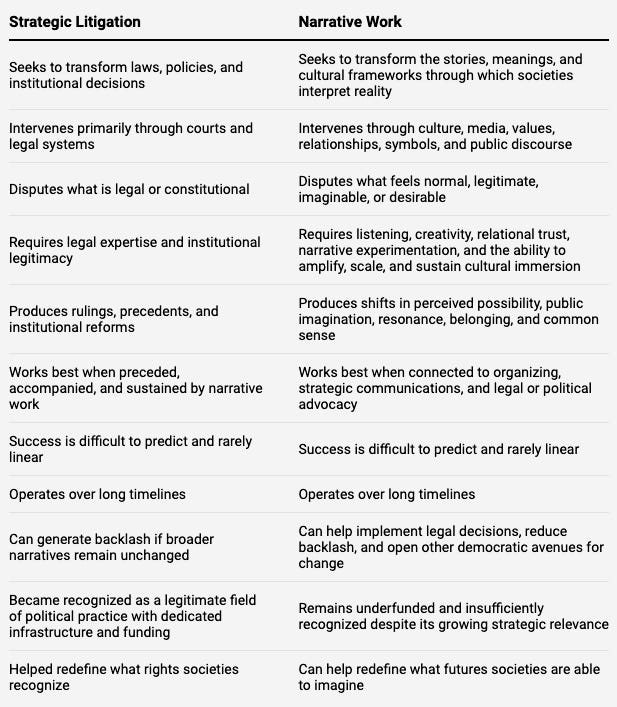
Not because I believe it should replace other strategies for change, but precisely because I believe the opposite: any effort toward legal or political transformation should be preceded, accompanied, and sustained by intentional efforts to transform the narratives through which societies make sense of reality.
Human beings have always told stories to understand the world and our place within it. But only recently have we begun to think more systematically about narratives as a central dimension of how social change operates.
Different intellectual traditions—from Antonio Gramsci to cultural studies, from critical theory to contemporary discourse analysis—have tried to name that which makes certain forms of power appear natural, inevitable, or even desirable. Hegemony. Ideology. Superstructure. Discourse. Different words for describing the frameworks of meaning that organize social life and define what a society considers normal, legitimate, or imaginable.
Narrative work seeks to intervene precisely there.
It seeks to challenge the stories that naturalize inequality, authoritarianism, or disconnection. And it also seeks to make other ways of understanding ourselves, relating to one another, and organizing collectively both possible and desirable.
That is why we have come to see narrative work as one of the conditions that makes litigation truly strategic in the first place. Litigation that remains confined to courtrooms may produce important legal victories, but litigation capable of transforming society must also contest common sense. It must recognize that narrative change matters as much as legal change. It must understand that it is not enough to be legally right; new interpretations of the world must become legible, emotionally resonant, and socially desirable. Litigation works best when it combines legal strategy with communications, narrative change, and social mobilization. And like all meaningful processes of social transformation, it requires long-term horizons while operating within the uncertain terrain of possibility: without guarantees, without magic formulas, and without total control over outcomes.
And yet, one of these components quickly gained legitimacy among much of progressive philanthropy, while the other still struggles to do so.
A Crisis of Meaning requires Narrative Infrastructure
This reflection surfaced recently in a gathering convened by Narrative Hive that brought together organizations from across the Global South working to build narrative infrastructure for social change, including Puentes, IRIS (International Resource for Impact and Storytelling), and the Nebula Fund. Again and again, the conversation returned to the same tension: despite the growing recognition that authoritarianism, polarization, and democratic erosion are also crises of meaning, narrative work still struggles to be understood as a serious field of political practice worthy of long-term investment.
Why, then, did strategic litigation become recognized as a serious field of political practice while narrative work remains comparatively marginal?
Perhaps because strategic litigation came backed by recognizable institutions: universities, courts, professional degrees, technical expertise. Perhaps because it seemed more tangible, more measurable, more “serious.” More “real.”
Narrative work, by contrast, is still often perceived as something diffuse, soft, or secondary. As though stories were merely decorative elements of politics rather than one of the central infrastructures of power.
But we are living through a historical moment defined precisely by a profound crisis of meaning. A time of democratic rupture, institutional capture, social fragmentation, and emotional exhaustion. A time in which many people feel that the world has ceased to be intelligible.
And in moments like this, narratives should begin to be seen for what they truly are: a powerful, actionable, and profoundly democratic tool for collective orientation.
Because societies are not sustained only by laws, public policy, or institutions. They are also sustained by stories that help answer fundamental questions: who we are, what we must protect, what futures are possible, and what is worth doing together.
That is why I believe despite the buzz, narrative work has deeply underestimated potential today. And perhaps that is why this stage of my life feels strangely familiar. Twenty years ago, I bet on an underestimated path to try to change the world. Today, I feel I am doing it again.
And I hope that those who have the ability to invest in this work will dare to do so as well. As the saying goes, the ideal time to have done it was 20 years ago. The second best time is now!